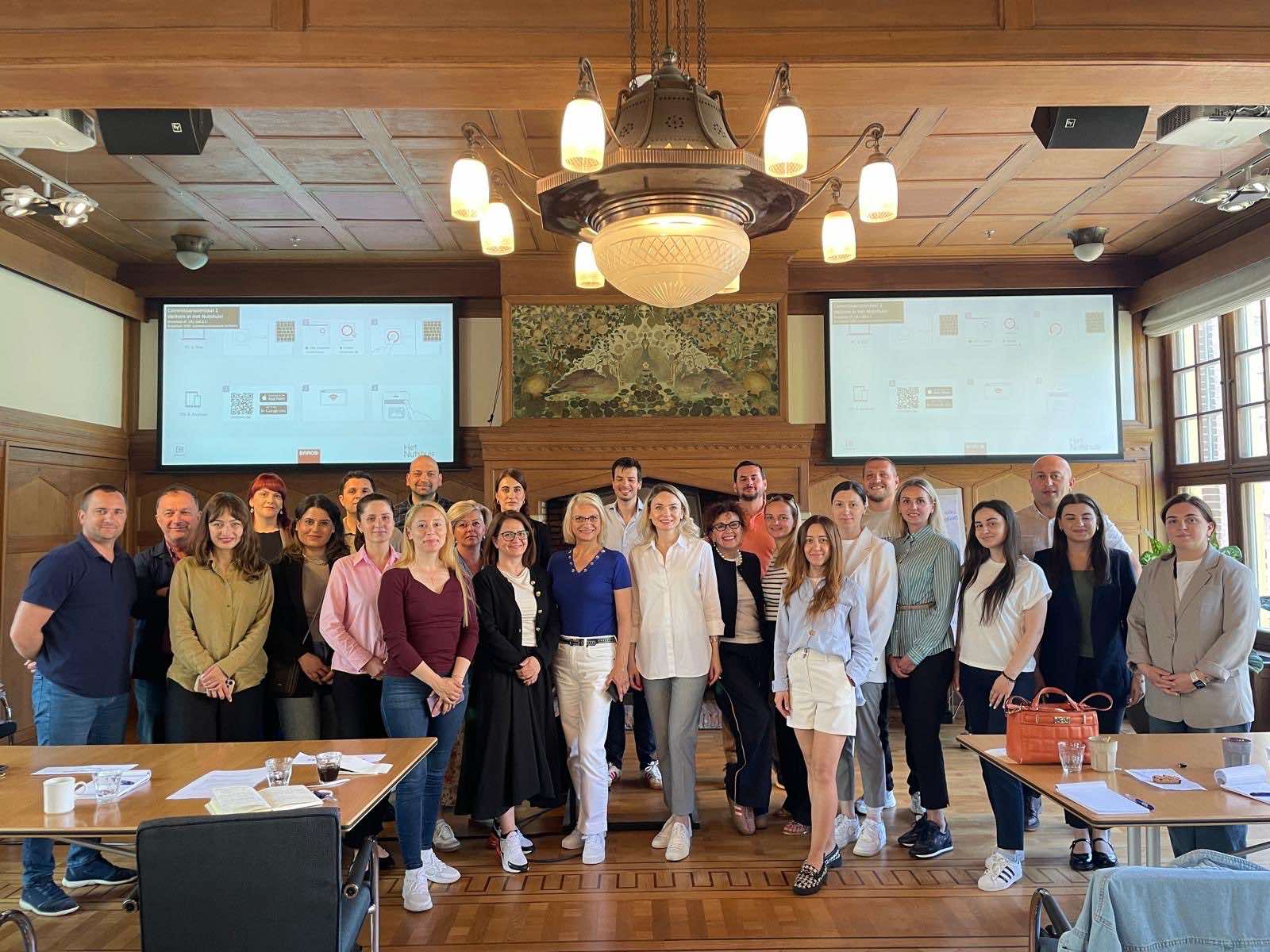
Ana Rutović, independent advisor for accreditation and reaccreditation at the Agency for Control and Quality Assurance of Higher Education, participated in the training program “Public Service Management” held in The Hague. The program was organized by the Netherlands Helsinki Committee, The Hague Academy for Local Governance, and the Faculty of Law of Leiden University, with financial support from the Dutch Ministry of Foreign Affairs. Participants in the program included representatives from the Western Balkans, as well as from Georgia, Turkey, Ukraine, Moldova, and Armenia.
Participation in the training provided direct insight into contemporary approaches to public administration and public service delivery in the context of the rule of law, democratic values, and European integration. The program was designed to connect theoretical knowledge with concrete practical examples, including direct engagement with representatives of municipalities, universities, European institutions, and the non-governmental sector. A particularly important aspect was that participants had the opportunity to analyze specific challenges and, with the support of mentors, develop a Back Home Action Plan (BHAP) – a set of concrete measures to be implemented within their home institutions.
The knowledge and contacts gained open opportunities for further networking and the development of institutional solutions in line with best practices from the EU. The implementation of the BHAP envisages the application of concrete steps in the field of digitalization of services, involving relevant internal and external stakeholders. The goal of the developed BHAP is to create a roadmap for integrating this activity into the Agency’s annual work program and other strategic governmental documents related to higher education and the digital transformation of public administration.
The specific issue identified by the Agency’s representative in the BHAP is the lack of digital processes in the field of quality assurance in higher education. The Agency still operates using a traditional work model, which creates a significant administrative burden for higher education institutions.
The introduction of digital tools and the creation of an online platform for application submission, modeled after other European agencies, would represent a significant step forward in the delivery of public services. It would also enhance the quality of application processing and facilitate the work of both Agency staff and external experts engaged in the evaluation process.